Key Points
- Objective: To evaluate yield and economics of traditional broadcast applications of dry fertilizer compared to 8” deep high concentrated strip-till banding of dry fertilizer.
- High Dry Fertilizer Cost: Higher dry fertilizer costs have made it challenging to see significant advantages of implementing dry fertilizer, whether banded or broadcast.
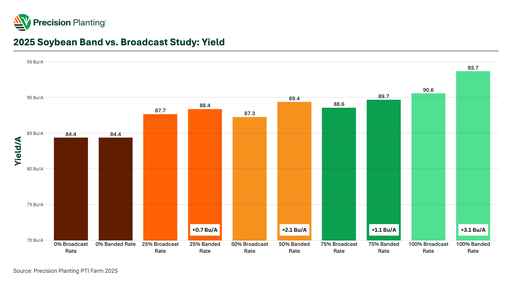
- Banded Advantage: In our direct comparisons, banding shows a consistent advantage over broadcast applications. In 2025, banding fertilizer outperformed broadcast applications at every rate percentage with yield gains of +0.7 to +3.1 Bu/A.
If we band dry fertilizer, can we reduce the rate due to its efficiency?
The conventional method of applying fertilizer is broadcasting, which covers every square inch of soil. The issue is that the fertilizer may not be getting to the roots or may not be as concentrated where you need it.
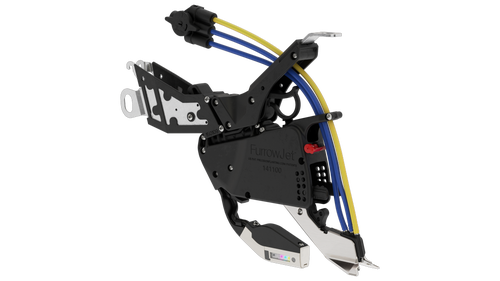
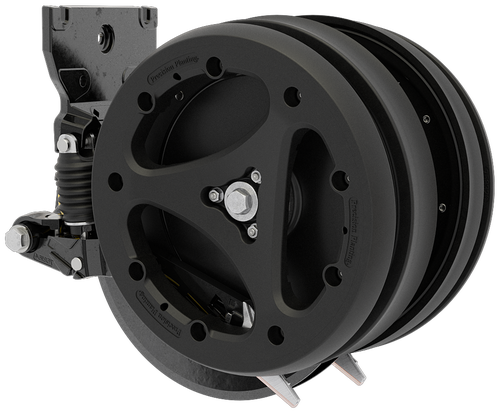
We took to the PTI Farm to evaluate the rate efficiency of dry fertilizer on soybeans. A Kuhn® Krause® Gladiator® pulling a Montag® Equipment 2208 Gen 2 fertilizer cart was used to implement this testing program for 2025.
To study rate efficiency, dry fertilizer was applied at 100%, 75%, 50%, 25%, and 0% rates in both strip-till bands and broadcast applications. We set out to discover the advantage banded dry fertilizer had over the broadcast method, and if we could in turn reduce the fertilizer rate due to higher efficiency.
Study Results
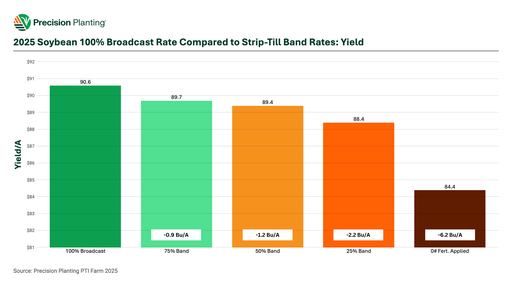
In 2025, banding out-performed all broadcast applications at every rate, with 100% and 50% offering the highest advantages at +3.1 Bu/A and +2.1 Bu/A. As rates fell to 25%, banding advantages were reduced to only +0.7 Bu/A.
In terms of economics, 100% rates offered the highest yield advantage of +6.2 Bu/A compared to 0% rates. 25%, 50%, and 75% fertilizer rates generated small losses of only -0.9/A to -2.2 Bu/A. Each of these losses were a result of little yield difference, but higher equipment cost for application.
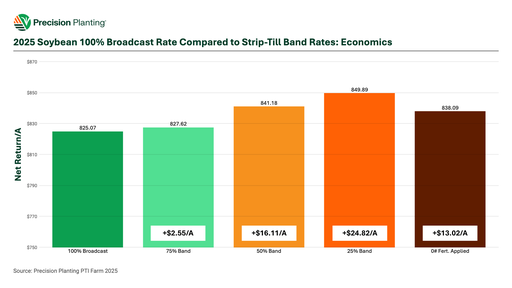
So what about efficiency? In 2025, banding 75% of the recommended dry fertilizer rate netted an additional $2.55/A compared to traditional broadcast spreading. As the dry fertilizer rate was reduced to 50%, it offered a $16.11/A advantage over 100% broadcast rates. 25% showed the greatest gains of +$24.82/A.
What’s concerning is that applying a 0% fertilizer rate offered advantages over the 100% broadcast rate by +$13.02/A. This simply means that there was not enough yield advantage from fertilizer to offset the high price of dry fertilizer.
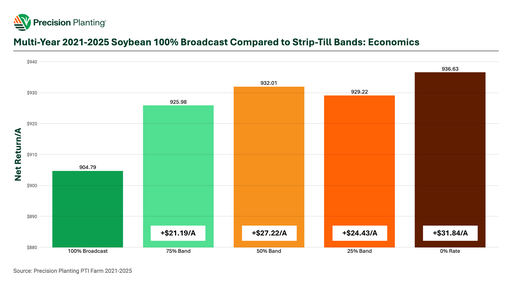
Our multi-year data from 2021-2025 shows that banding 75-25% rates of dry fertilizer has led to returns of +$21.19 to +$27.22/A over traditional broadcast spreading. However, just as 2025 revealed, 0% rates were even higher at a +$31.84/A advantage.
As we continue to monitor this data as a part of our 10-year study, it will be interesting over the next 5-year period to evaluate yield and economics as both dry fertilizer and commodity prices fluctuate.
Study Details
Study data collected 2021-2025 at the PTI Farm in Pontiac, IL.
| Planting Date | 2025 - April 20th 2024 - April 20th 2023 - April 20th 2022 - May 20th 2021 - April 27th | Rotation | BAC |
| Row Width | 30" | Population | 120K-130K |
| Soybean Prices | 2025 - $9.93 2024 - $11.46 2023 - $13.09 2022 - $13.96 2021 - $11.98 | Hybrid | 2025 - Asgrow 27FX3 2024 - Asgrow 27FX3 2023 - Asgrow 27FX3 2022 - Asgrow 27FX1 2021 - AG 35XF1 |
Related Tags